
In hotel development, one number defines the viability of your entire project before a single brick is laid: the cost per key. Understanding it — and mastering its components — is the difference between a hotel that delivers returns and one that underperforms for decades.
Whether you are developing a select-service property in a secondary market or a luxury resort on a prime coastline, the cost per key is the fundamental unit of measure that lenders, investors, operators, and consultants use to evaluate, compare, and green-light hotel projects. Yet surprisingly, many developers and investors still approach it with incomplete or outdated data.
In this guide, we break down exactly what hotel cost per key means, what goes into it, what benchmarks look like across segments in 2025–2026, and — critically — why it must be analyzed alongside the right revenue and return metrics before any commitment is made.
Table of Contents
WHAT IS HOTEL COST PER KEY?
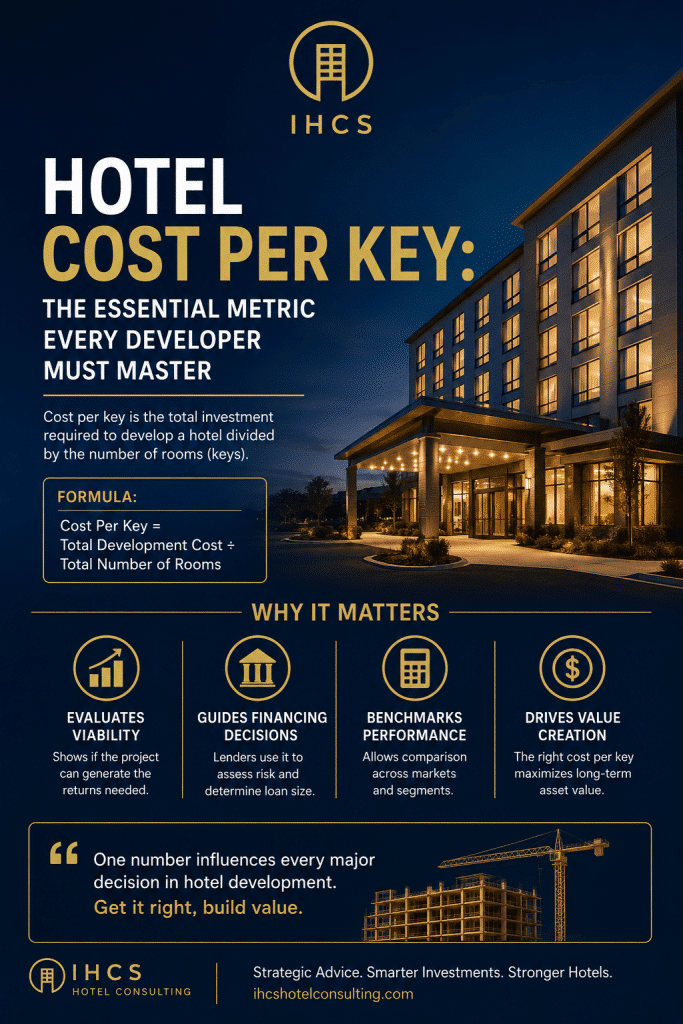
Cost per key — also called cost per room — is the total investment required to develop a hotel divided by the number of guest rooms (or “keys”). It represents the all-in capital expenditure per unit of revenue-generating capacity.
Formula:
Cost Per Key = Total Development Cost ÷ Total Number of Rooms
For example, if a 150-room select-service hotel costs $33,000,000 to develop in full, the cost per key is $220,000. That single number immediately tells an experienced investor how the project compares to market standards, whether the capital stack is realistic, and what ADR and occupancy levels are needed to generate an acceptable return.
Before committing to any development budget, a structured feasibility study is non-negotiable. Read more in:
Importance of a Feasibility Study Before Building a Hotel
THE SIX COMPONENTS OF TOTAL DEVELOPMENT COST
Cost per key is not simply a construction number. It aggregates every category of capital expenditure required to take a project from raw land to an operational hotel. These six components must all be accounted for to produce an accurate figure.
01 — LAND ACQUISITION
Purchase price, closing costs, entitlement fees, and carrying costs during development. Highly variable by location — often the single largest wildcard in urban projects.
02 — HARD COSTS
Site work, structure, envelope, HVAC/MEP, plumbing, electrical, and interior finishes. Typically represents 50–55% of total budget. The most sensitive to labor and material inflation.
03 — SOFT COSTS
Architecture, engineering, permits, legal, insurance, financing, and project management. Commonly planned at 20–30% of hard costs. Often underestimated in early-stage pro formas.
04 — FF&E (Furniture, Fixtures & Equipment)
Guestroom furniture, casegoods, lighting, décor. Typically 7–12% of total construction cost. For luxury hotels, FF&E alone can exceed $100,000 per key.
05 — PRE-OPENING COSTS
Hiring, training, marketing, initial inventory, and technology systems. Often 3–5% of total project cost and one of the most overlooked items in developer budgets.
06 — CONTINGENCY
A reserve of 5–10% of hard costs for unforeseen conditions, design changes, or market disruptions. Any lender will require this to be funded before approving a construction loan.
For a broader overview of hotel planning variables, see:
What Are the Aspects to Consider in Hotel Development?
2025–2026 BENCHMARKS BY HOTEL SEGMENT
The following figures represent total development cost per key, inclusive of all six components above. Land cost is typically excluded and added separately based on specific market conditions.
| Hotel Segment | Cost Per Key |
|---|---|
| Economy / Budget (Motel 6, Red Roof Inn) | $90,000 – $130,000 |
| Limited-Service Midscale (Holiday Inn Express, Hampton Inn) | $140,000 – $185,000 |
| Extended Stay (Residence Inn, Homewood Suites) | $155,000 – $210,000 |
| Select-Service Upper Midscale (Courtyard, Hilton Garden Inn) | $200,000 – $280,000 |
| Full-Service Upscale (Marriott, Hyatt Regency) | $350,000 – $600,000 |
| Luxury / Upper Upscale (Four Seasons, Ritz-Carlton, Aman) | $1,000,000 – $2,000,000+ |
“Luxury hotels are more expensive than ever to build — exceeding $2 million per key in gateway cities. The constraint is not appetite; it is access to properly structured capital.”
Key Data Points
- $167,000 — Median cost/key for Limited-Service hotels (HVS 2025)
- $2M+ — Peak cost/key for Luxury Urban Hotels (2025)
- 50–55% — Hard costs as share of total budget
- 7–12% — FF&E as share of total construction cost
FIVE FACTORS THAT DRIVE COST PER KEY UP — OR DOWN
Two hotels targeting the same segment in the same city can still have very different costs per key. Understanding the levers that drive that variance is essential.
1. LOCATION AND LAND COST
Urban core locations can add $50,000–$200,000 per key in land cost before a single foundation is poured. Suburban and secondary market sites dramatically reduce this exposure, which is one reason limited-service brands have historically concentrated development outside primary markets.
2. LABOR MARKETS
Post-2020, mechanical and electrical labor remains critically constrained in most major markets. Union jurisdictions carry substantial premium costs. Markets in the Sun Belt and secondary Midwest cities have offered relative relief.
3. BRAND STANDARDS AND PROTOTYPES
Branded hotels must comply with prototype requirements that define minimum room sizes, lobby configurations, amenity sets, and technology infrastructure. These specifications have grown more complex and costly over time, particularly in the upper-midscale and upscale tiers.
To understand the strategic role consultants play during development, read:
Hotel Consulting: The Strategic Bridge Between Investor and Operator
4. DESIGN AND ARCHITECTURAL COMPLEXITY
Boutique and lifestyle hotels often carry higher design costs than branded boxes. However, when the revenue premium is properly modeled, the higher cost per key can be fully justified.
5. MATERIAL COSTS AND SUPPLY CHAIN
Material pricing has not returned to pre-2020 levels. Steel, copper, lumber, and concrete all remain elevated. International projects face additional exposure through import duties and logistics costs.
COST PER KEY AS AN INVESTMENT METRIC
Cost per key is not just a construction benchmark — it is a foundational investment evaluation tool. Lenders and equity investors use it alongside several key ratios to determine whether a project is financially viable.
THE COST-PER-KEY-TO-REVPAR RATIO
A widely used rule of thumb holds that a hotel should achieve annual RevPAR equal to approximately 10–15% of its total development cost per key. A project costing $200,000 per key should target $20,000–$30,000 in annual RevPAR — roughly $55–$82 per night at 100% occupancy.
DEBT SIZING AND LTV CONSTRAINTS
Construction lenders typically size debt at 55–65% of total project cost. In a tighter credit environment, lenders apply stricter stress tests and lower LTV ceilings, meaning the equity requirement per key has increased substantially.
For a deeper look at hotel financing structures, see:
Financing for Hotel Projects: What Are Our Options?
CAP RATE AND EXIT VALUE
If luxury hotel transactions in a market are clearing at $800,000 per key, a developer who can build at $550,000 per key has meaningful value-creation potential at stabilization. This spread between replacement cost and transaction value is one of the most powerful arguments for development over acquisition in certain market cycles.
CONNECTING COST PER KEY TO OPERATING PROFITABILITY (GOP)
A high cost per key sets a higher bar for operating performance. The hotel must generate sufficient Gross Operating Profit (GOP) to service debt, provide a return on equity, fund ongoing capital reserves, and support a compelling exit value.
Key Considerations
- High cost per key requires proportionally higher RevPAR to sustain returns
- GOP margins of 30–45% are typically required to service stabilized hotel debt
- Operator selection must be aligned with the revenue expectations in the development pro forma
- Ongoing FF&E reserves ($1,000–$3,000 per room/year) must be built into the operating model
- Pre-opening cost recovery must be factored into Year 1 and Year 2 financial projections
For strategies focused on operational profitability, read:
Operational Profitability: How to Improve Your GOP
COMMON MISTAKES DEVELOPERS MAKE WITH COST PER KEY
MISTAKE 1 — Using Industry Averages as Project Budgets
Segment medians are useful for benchmarking, not for budgeting. A $167,000 median cost per key for limited-service hotels is an average across markets, conditions, and project types. Applying it as a budget ceiling in a high-cost-of-labor market with a complex site will produce a chronically underfunded project.
MISTAKE 2 — Excluding Land from Cost Per Key
Land cost must be included in the full cost-per-key analysis for investment purposes. An investor who models returns against a construction-only cost per key will systematically underestimate the equity need.
MISTAKE 3 — Ignoring Pre-Opening and Soft Costs
Pre-opening costs and soft costs frequently represent 25–35% of a project’s total development cost. Developers who under-model these categories often face forced equity calls at the worst possible moment.
MISTAKE 4 — Failing to Stress-Test Against Market Rate
Cost per key must always be validated against a realistic ADR and occupancy projection for the specific market. Building at $280,000 per key in a market where the comp set averages $110 ADR at 65% occupancy is a structural mismatch no operational excellence can fully overcome.
For investors seeking support with hotel development and capital sourcing, see:
We Want to Develop Your Hotel Project and Support You in Finding Investors
CONCLUSION: ONE NUMBER, MANY DECISIONS
Hotel cost per key is deceptively simple as a formula and profoundly complex in its implications. It is the lens through which every financial decision in hotel development is evaluated — from land acquisition strategy to brand selection, from financing structure to exit timing.
Getting it right requires integrating construction expertise, market knowledge, financial modeling discipline, and operational insight. No single component can be analyzed in isolation. The budget must be tested against revenue potential. The financing structure must be aligned with equity return requirements. The operating model must be calibrated to support the debt service embedded in the development cost.
For investors and developers who approach cost per key with this level of rigor, it becomes not just a metric but a strategic compass — the foundation on which profitable, resilient hotel assets are built.




