
When we talk about an accessible hotel, we mean much more than simply following a rule or regulation. It’s about a commitment to equality and inclusion for everyone, regardless of their abilities. But to make this possible, you need to know where to start.
That’s why, in this article, we’ll outline the basic accessibility requirements. By following them, you can begin to develop a hotel that’s accessible to everyone. You’ll also discover that it’s not just about complying with regulations, but also about providing a great experience.
Table of Contents
1. Ensuring Access for Everyone
We could say that access is the cornerstone that opens the door to an accessible hotel. After all, access allows visitors to enter the hotel and enjoy all its facilities. Thus, without adequate access, all other efforts to improve accessibility would be meaningless.
Access, in its most basic form, is intrinsically linked to the design and size of doors. And while this may seem obvious or simple, behind this apparent simplicity lies the need to carefully consider every detail. A door is not just a means of entry; it is the starting point for a customer’s experience.
Let’s imagine for a moment that we’re standing in front of a narrow doorway or a step. For some people, this can be an insurmountable obstacle. People who use wheelchairs or other assistive devices may find their path blocked by a single step.
In reality, a truly accessible hotel begins right here, at the entrance. Therefore, designing an appropriate entrance is more than just an obligation. It is a welcoming gesture that demonstrates a hotel’s commitment to the comfort and satisfaction of all its guests.
2. Ensuring Accessibility
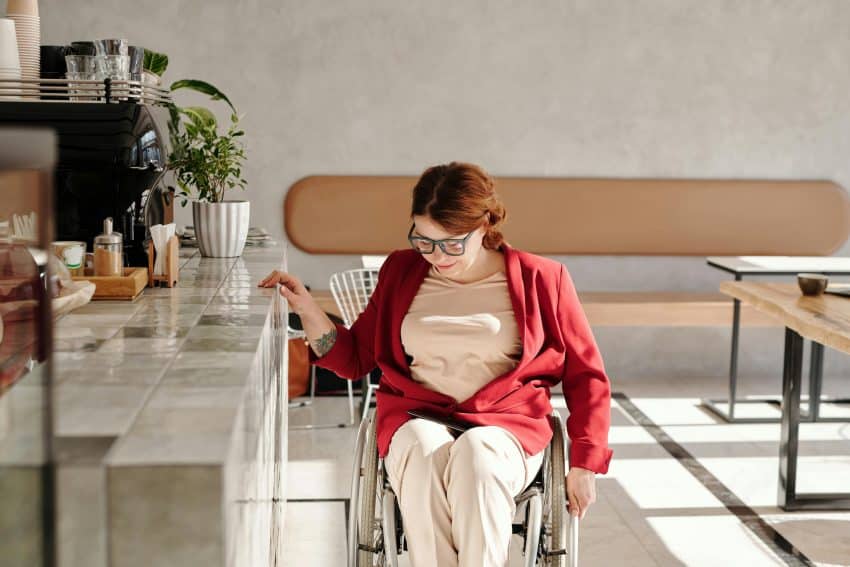
Gaining access to a hotel is only the first step in the quest for a truly inclusive experience. Once inside, the ability to move about freely ensures that everyone can enjoy the facilities and services.
Accessibility in a hotel goes beyond simply being able to enter. It’s about the freedom to move, turn, and explore without obstacles. In this regard, seemingly small details—such as the size of spaces and the arrangement of furniture—have a huge impact.
The ability to move freely within an accessible hotel is an essential component . Therefore, it is the responsibility of hotel designers and owners to ensure that certain requirements are met. In this way, it is possible to develop a hotel project that promotes accessibility.
3. Facilitate communication
The ability to communicate effectively through all possible means is another basic requirement for an accessible hotel. Every detail must contribute to creating an environment where guests can communicate with hotel staff without barriers . This ranges from information panels and signage to verbal and tactile communication, as well as visual and audible signals.
An important point here is that hotel staff must be trained to communicate effectively with everyone . This may include the need to use sign language to communicate with people who are deaf or hard of hearing. It also involves having the patience and empathy to communicate with people who have speech difficulties.
4. Encourage the use of everything
What’s the point of having a well-designed environment if we can’t fully interact with what it has to offer? The ability to use the elements associated with the facility is what completes the equation of an accessible hotel .
When we talk about “use,” we are referring to a series of parameters. These are essential to ensure that all users can enjoy the hotel’s accessible facilities and services. These parameters include reach, operation, and grip.
On the one hand, reach refers to the distance a person can comfortably reach. Operability relates to how easily a person can operate the devices. And finally, grip is a critical factor, especially for people with motor disabilities. In this regard, grab bars in bathrooms and showers are an example of how design can facilitate a secure grip.
Conclusion
An accessible hotel is committed to providing the best experiences, regardless of a person’s abilities or limitations. And to make this possible, certain requirements must be met, such as good access, mobility, communication, and usability of the space.
By following these basic accessibility requirements, hotels can make a difference and become truly welcoming destinations .





