May 2026 · Reading time: 8 min
Introduction
In an increasingly competitive and sophisticated hotel industry, owners and investors can no longer afford to manage their assets passively. A hotel’s profitability does not depend solely on occupancy or the brand that operates it: it depends, to a large extent, on how well the asset’s value is monitored, optimized, and protected over time.
This is where hotel asset management becomes an indispensable strategic tool. In this article, we explain what it is, how it works, and why every investor or owner should incorporate it into their management structure.
What Is Hotel Asset Management?
Hotel asset management is the discipline responsible for maximizing the value and profitability of a real estate asset used for hotel purposes, serving as a strategic bridge between the owner or investor and the hotel operator (whether an international chain, an independent operator, or the management team itself).
Unlike operational management—which handles the day-to-day operations of the hotel—the Asset Manager takes a long-term perspective focused on creating value, protecting invested capital, and aligning the owner’s interests with those of the operator.
|
|

Asset Manager vs. Hotel Operator: What’s the Difference?
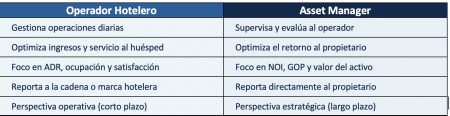
A common misconception is to equate asset management with hotel management. Although they work closely together, their roles are fundamentally different:
The KPIs That an Asset Manager Monitors
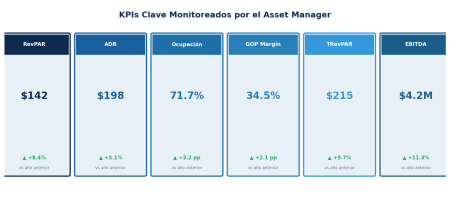
An effective asset manager works with a balanced scorecard that goes far beyond occupancy. They continuously monitor the following key indicators to detect deviations and opportunities in a timely manner:
Tangible Benefits for Investors and Owners
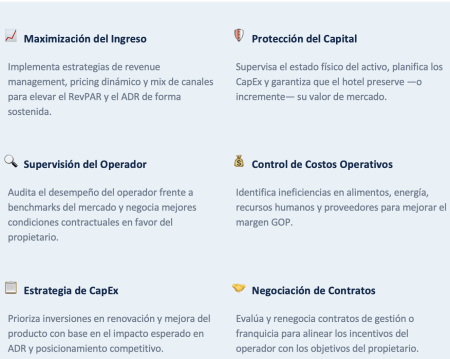
Incorporating a professional asset manager into the management structure of a hotel or hotel portfolio generates tangible and measurable benefits. Below, we detail the most relevant ones for investors:
When Is the Right Time to Hire an Asset Manager?
Hotel asset management adds value at any stage of an asset’s life cycle, but there are critical moments when its role is particularly crucial:
- Asset Acquisition: Evaluates operational due diligence, potential for improvement, and the terms of the management contract before closing the transaction.
- Operator transition: When changing hotel chains or operating models, the asset manager oversees the process while minimizing the impact on financial results.
- Repositioning: If the hotel requires renovation, a change in market segment, or rebranding, the Asset Manager leads the value strategy.
- Continuous optimization: in multi-property portfolios where individual oversight would be unfeasible without a specialized team.
- Preparation for sale: Maximize the asking price by improving NOI and presenting a solid track record to potential buyers.
|
|

Conclusion
Hotel asset management is no longer a luxury reserved for large investment funds; it has become a strategic necessity for any serious owner who wants to maximize the return on their hotel investment.
In an environment characterized by tight margins, sophisticated operators, and intense competition, having a professional who exclusively represents the owner’s interests—who audits, optimizes, and negotiates—can make the difference between an average asset and a truly profitable one.
If you are an investor or hotel owner and do not yet have an asset manager as part of your organization, the question is not whether you can afford one. The question is whether you can afford not to have one.