
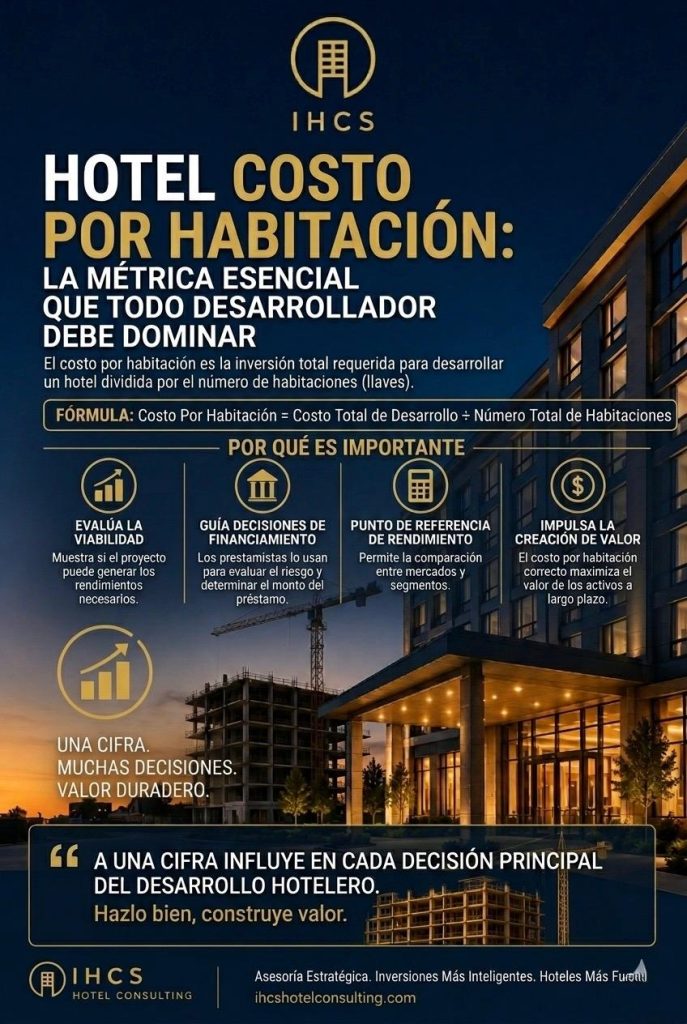
In hotel development, there is one figure that determines the viability of an entire project before a single brick is laid: the cost perkey. Understandingit—and mastering all its components—is the difference between a hotel that generates profitability and one that struggles with mediocre results for decades.
Whether you’re developing a select-service hotel in a secondary market or a luxury beachfront resort, the cost per key is the fundamental unit of measurement that investors, banks, operators, and consultants use to evaluate, compare, and approve hotel projects. However, many developers and investors still work with incomplete or outdated data.
In this guide, we examine exactly what “hotel cost per key” means, what factors make it up, what the industry benchmarks are for 2025–2026, and—most importantly—why it should be analyzed alongside the appropriate revenue and profitability metrics before making any investment decisions.
Table of Contents
WHAT IS HOTEL COST PER KEY?
Cost per key —also known as cost per room—is the total investment required to develop a hotel divided by the number of rooms (or “keys”). It represents the total capital expenditure per unit of revenue-generating capacity.
Formula:
Cost per Unit = Total Development Cost ÷ Total Number of Rooms
For example, if a 150-room select-service hotel costs $33 million to fully develop, the cost per room will be $220,000. That single figure allows an experienced investor to compare the project with market standards, assess whether the financial structure is realistic, and determine what ADR and occupancy levels will be necessary to achieve adequate profitability.
Before committing to any development budget, conducting a feasibility study is essential. You can learn more about it here:
The Importance of a Feasibility Study Before Building a Hotel
THE SIX COMPONENTS OF THE TOTAL DEVELOPMENT COST
The cost per key is not just a construction figure. It includes all categories of investment necessary to take a project from land acquisition to the hotel’s operational opening.
01 — LAND ACQUISITION
It includes the purchase price, closing costs, zoning permits, and financing costs during development. It varies greatly depending on the location and is often the most unpredictable factor in urban projects.
02 — HARD COSTS (CONSTRUCTION COSTS)
Earthwork, structural work, exterior cladding, HVAC/MEP systems, plumbing, electrical work, and interior finishes. These account for approximately 50% to 55% of the total budget and are particularly sensitive to inflation in materials and labor costs.
03 — SOFT COSTS
Architecture, engineering, permits, legal counsel, insurance, financing, and project management. These typically account for 20–30% of construction costs and are often underestimated in the early stages.
04 — FF&E (Furniture, Fixtures, and Equipment)
Furniture, lighting, decor, and room furnishings. This typically accounts for between 7% and 12% of the total construction cost. In luxury hotels, FF&E can exceed $100,000 per room.
05 — PRE-OPENING COSTS
Hiring, training, marketing, initial inventory, and technology systems. These typically account for between 3% and 5% of the total project cost and are one of the most overlooked items in many budgets.
06 — CONTIINGENCY
A financial reserve equivalent to 5–10% of construction costs, set aside for unforeseen events, design changes, or market disruptions. No bank will approve financing without this item properly accounted for.
To learn more about key variables in hotel development, see:
What Are the Aspects to Consider in Hotel Development?
BENCHMARKS FOR 2025–2026 BY HOTEL SEGMENT
The following figures represent the total turnkey development cost, including all the components mentioned above. The cost of land is typically analyzed separately, depending on the market.
| Hospitality Sector | Turnkey Cost |
|---|---|
| Economy / Budget (Motel 6, Red Roof Inn) | $90,000 – $130,000 |
| Limited-Service Midscale (Holiday Inn Express, Hampton Inn) | $140,000 – $185,000 |
| Extended Stay (Residence Inn, Homewood Suites) | $155,000 – $210,000 |
| Select-Service Upper Midscale (Courtyard, Hilton Garden Inn) | $200,000 – $280,000 |
| Full-Service Upscale (Marriott, Hyatt Regency) | $350,000 – $600,000 |
| Luxury / Upper Upscale (Four Seasons, Ritz-Carlton, Aman) | $1M – $2M+ |
“Luxury hotels are more expensive than ever to build—exceeding $2 million per room in gateway cities. The problem isn’t demand; it’s access to adequate capital structures.”
Key Facts
- $167,000 — Average cost per room in limited-service hotels (HVS 2025)
- $2M+ — Maximum cost per room in luxury urban hotels
- 50–55% — Percentage of construction costs relative to the total budget
- 7–12% — Percentage of FF&E in construction costs
FIVE FACTORS THAT DRIVE UP—OR DOWN—THE COST PER ROOM
Two hotels in the same segment and in the same city can have radically different costs per room. Understanding what drives these differences is essential.
1. LOCATION AND LAND COSTS
Premium urban locations can add between $50,000 and $200,000 per unit in land costs alone. Secondary and suburban markets significantly reduce that financial burden.
2. LABOR MARKET
Since 2020, there has been a severe shortage of skilled labor in mechanical and electrical installations. Unionized markets have significantly higher costs.
3. BRAND STANDARDS AND PROTOTYPES
Chain hotels must meet specific standards regarding room size, lobby design, amenities, and technological infrastructure. These requirements have become increasingly complex and costly.
To understand the strategic role of hotel consulting in these processes, see:
Hotel Consulting: The Strategic Bridge Between Investor and Operator
4. DESIGN AND ARCHITECTURAL COMPLEXITY
Boutique and lifestyle hotels typically have higher design costs than standardized projects. However, if the increase in revenue is properly modeled, the higher cost per room can be fully justified.
5. MATERIAL COSTS AND SUPPLY CHAIN
The prices of materials such as steel, copper, concrete, and wood remain above pre-2020 levels. International projects also face additional costs related to logistics and imports.
COST PER KEY AS AN INVESTMENT METRIC
Cost per key is not just a construction metric: it is an essential tool for evaluating hotel investments. Banks and investors use it along with other financial ratios to determine a project’s viability.
THE COST PER KEY / REVPAR RATIO
There is a widely used rule of thumb: a hotel should generate an annual RevPAR equivalent to approximately 10–15% of its total cost per room. A hotel built at a cost of $200,000 per room should aim to generate between $20,000 and $30,000 in annual RevPAR.
FINANCING AND LTV LIMITS
Banks typically finance between 55% and 65% of the total project cost. In more restrictive credit environments, banks impose stricter requirements and lower loan-to-value (LTV) ratios, thereby increasing the amount of capital required from the investor.
To learn more about hotel financing, you can read:
Financing for Hotel Projects: What Are Our Options?
CAP RATE AND EXIT VALUE
If luxury hotels in a given market sell for $800,000 per unit and a developer manages to build them for $550,000 per unit, there is significant potential for value creation once the project stabilizes and is sold.
LINKING TURNKEY COST TO OPERATING PROFIT (GOP)
A high cost per room entails greater operational demands. The hotel must generate sufficient GOP (Gross Operating Profit) to cover debt, generate a return on invested capital, and maintain reserves for future renovations.
Key Considerations
- A higher cost per room requires a proportionally higher RevPAR
- GOP margins of 30–45% are typically required to cover stabilized debt
- The selection of the operator must align with the project’s financial projections
- FF&E reserves ($1,000–$3,000 per room per year) must be included in the operating model
- Pre-opening costs must be recouped in the projections for the first few years
To learn about strategies focused on operational profitability, see:
Operational Profitability: How to Improve Your GOP
COMMON MISTAKES MADE BY DEVELOPERS
ERROR 1 — Using industry averages as a budget
Benchmarks are used to compare projects, not to set actual budgets.
ERROR 2 — Excluding the cost of land
Analyzing only construction costs creates a false impression of profitability and underestimates actual capital requirements.
ERROR 3 — Ignoring soft costs and pre-opening costs
These items can account for up to 35% of the total project cost.
ERROR 4 — Failing to validate the project against the market ADR
Building at excessively high costs in markets with low ADRs creates structural imbalances that cannot be corrected through effective operations alone.
For investors interested in hotel development and raising capital, please visit:
We Want to Develop Your Hotel Project and Help You Find Investors
CONCLUSION: ONE NUMBER, MANY DECISIONS
Hotel cost per key seems like a simple formula, but its implications are deeply complex. It is the metric used to evaluate virtually all financial decisions in a hotel project: from land acquisition to the exit strategy.
Calculating this correctly requires combining construction experience, market knowledge, financial discipline, and operational insight. No single component can be analyzed in isolation. The budget must be validated against revenue potential. Financing must align with profitability expectations. And the operating model must be capable of supporting the debt structure resulting from the development.
For investors and developers who understand cost per key at this level of depth, it ceases to be merely a metric and becomes a true strategic compass for building profitable and resilient hotel assets.
MORE POSTS FROM THE IHCS BLOG
- Hotel Management Contracts: Lease vs. Management
- Hotel Project Development and Optimization
- Increase GOPPAR and Profitability in Independent Hotels





