
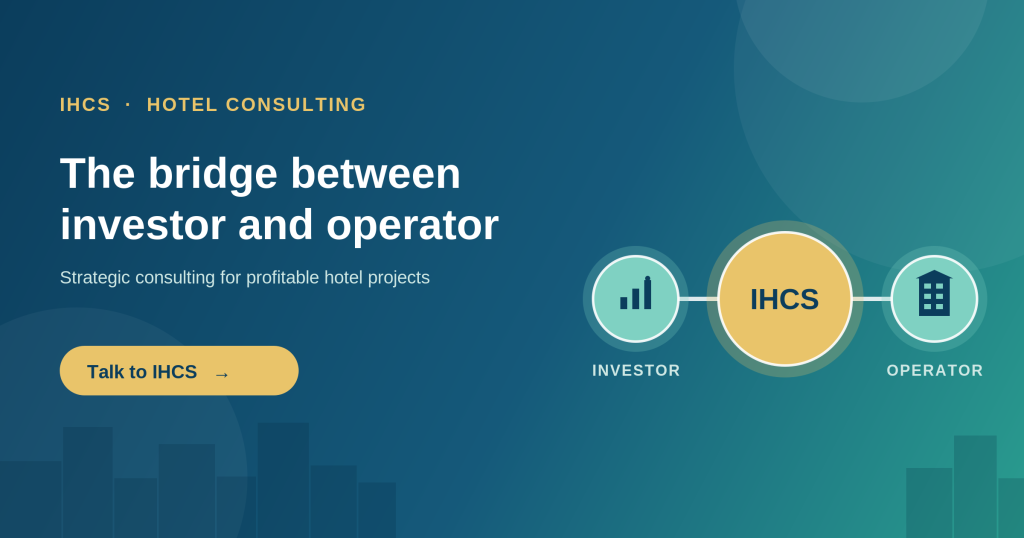
When developing a hotel project, there is often a gap between the investor’s vision and the operator’s execution. What looks aesthetically stunning is not always operationally efficient, and what is functional for staff is not always profitable for ownership. This is where good hotel consulting becomes indispensable. At IHCS, our role is not just to advise — we act as a strategic bridge that ensures every project is coherent, viable and, above all, a financial success.
In this article we explain what external hotel consulting brings to the table, how it differs from the operator’s role, when it makes sense to hire one, and the five concrete reasons why IHCS is the right ally for your investment.
Table of Contents
The gap between investor and operator
The investor wants one core thing: profitability and asset appreciation. The operator, on the other hand, focuses on meeting brand standards, sustaining sales volume and building a recognizable operation. Both goals are legitimate, but they don’t always align: they can clash on design decisions, on resource allocation, on pricing strategy or on which KPIs get prioritized. That friction, when unmanaged, costs both money and time.
The role of IHCS as an external consultant
External hotel consulting operates at a level above day-to-day management. It analyzes, recommends and supports the high-stakes decisions that affect both asset value and investment returns. At IHCS we have been doing this for more than 26 years across 14 countries, with more than 215 success stories behind us. That experience is what lets us mediate, anticipate problems and turn a vision into a profitable operation.
Here are the five reasons why hiring a hotel consultant like IHCS makes a real difference.
1. Objective, bias-free vision
In internal management, it is easy to fall into “tunnel vision” or emotional attachment to certain designs, brands or processes. As external consultants, we bring a neutral perspective grounded strictly in data and international standards. That objectivity allows us to spot risks others overlook and prioritize decisions that protect the long-term health of the asset.
2. Aligning interests between owner and operator
As mentioned, an investor’s goals (profitability and asset value) and an operator’s goals (brand standards and sales volume) do not always match. At IHCS we act as expert mediators: we make sure the operator meets the agreed KPIs without compromising the owner’s resources, building a “win-win” relationship that gives the project long-term stability.
3. Optimizing operational efficiency from the design stage
Our technical expertise lets us review blueprints and processes before they become costly, hard-to-change realities. A poorly designed hotel can increase labor costs by 15-20% over its lifetime. We step in to keep workflows seamless, cutting unnecessary expenses and maximizing profit margins from day one of operations. You can dive deeper into this approach in our article on hotel operational analysis and its importance in the GOP.
4. Access to a global network of specialized knowledge
Hiring IHCS means tapping into more than 26 years of accumulated knowledge across 14 countries. We don’t bring theory — we bring practical solutions that have already worked in more than 215 success stories. That network lets us connect our clients with the best providers, operators and talent in the industry, speeding up execution timelines.
5. Quality assurance and standards auditing
We act as the guardians of the project’s excellence. We supervise every stage — from the feasibility study to the opening — to ensure it meets the industry’s highest standards. We use tools such as the Mystery Guest to audit the real guest experience and spot any deviation. For us, quality is non-negotiable: it is the foundation on which a hotel’s reputation, and its ability to attract a discerning guest, is built.
Difference between a hotel operator and a hotel consultant
This is one of the most common questions in the industry. The hotel operator is the company that runs the hotel day to day: teams, brand, sales and operations. The hotel consultant works one level above: analyzing the business, advising the owner on strategic decisions, supervising the operator and making sure the asset meets its financial goals. Once a hotel is run by a third-party operator, the consultant can act as the owner’s representative, monitoring contract compliance and maximizing the asset’s profitability.
When does it make sense to hire a hotel consultant?
Any moment can be the right one, but there are stages where the return on hiring a good consultant is especially high:
- At the feasibility study stage, before committing the investment.
- During design and construction, to avoid costly mistakes that are expensive or impossible to fix later.
- When selecting an operator or brand, to negotiate terms that protect the owner.
- At the hotel’s opening, to ensure agreed standards are met.
- For operating hotels that are underperforming their potential.
- During repositioning, sale or refinancing of the asset.
In summary
External hotel consulting is not an added cost — it is an investment in security. At IHCS we turn the complex relationship between investors and operators into a solid and efficient structure. We are the ally that makes sure your vision is not lost in execution, but instead becomes a profitable and meaningful reality.
Frequently asked questions about hotel consulting
What is hotel consulting? It is the professional service in which an independent expert advises hotel owners, investors or asset managers on strategic, operational or transactional decisions related to their hotels, with a focus on profitability and asset value.
What services does a hotel consulting firm offer? Market analysis and feasibility studies, design and construction advisory, operator and brand selection, revenue management, operational optimization, standards auditing, hotel asset management and owner representation against the operator.
What is the difference between a hotel operator and a hotel consultant? The operator runs the hotel day to day (teams, brand, sales, operations). The consultant works at a higher strategic level: analyzing the business, advising the owner on major decisions and supervising that the operator meets KPIs and contract terms.
When should you hire a hotel consultant? At the feasibility study stage, during design and construction, when choosing an operator or brand, at the opening, when a hotel is underperforming its potential, and during repositioning, sale or refinancing of the asset.
What are the benefits of hiring an external hotel consultant? An objective, bias-free vision, alignment of interests between owner and operator, greater operational efficiency, access to a global network of expertise, standards auditing and, as a result, higher profitability and lower risk for the investor.
How much does hotel consulting cost? It depends on the project’s scope, the type of hotel and the duration of the engagement. It usually takes the form of a fixed project fee, a monthly retainer or a variable fee linked to results. The best way to find out is to request a tailored proposal.
What is hotel asset management? It is the discipline that protects the profitability and value of the hotel as an investment asset. It involves supervising the operator, monitoring financial KPIs, optimizing CapEx and representing the owner in every decision that affects asset performance.
Talk to IHCS
If you are developing a hotel project or looking to optimize the profitability of an existing one, IHCS can support you from the first analysis to operations.
Recommended reading from the IHCS blog:




